


The Deemed Disposal Rules for Australians Who Move Overseas


Key points
Moving overseas can trigger a Capital Gains Tax event. When you cease Australian tax residency, you may be deemed to have disposed of certain investment assets at market value, even if you haven't sold them.
You generally have a choice in how the rules apply. Eligible Australians can either recognise the capital gain when they leave Australia or defer the deemed disposal, with each option having different long-term tax implications.
Planning before you become a non-resident is essential. Understanding which assets are affected, confirming your tax residency cessation date, and obtaining professional advice can help you minimise unexpected tax outcomes and make informed financial decisions.
If you're planning to leave Australia permanently or for an extended period, there are a number of financial and tax issues you'll need to consider. One of the most important, and one that many Australians are unaware of, is the Capital Gains Tax (CGT) deemed disposal rules.
These rules can have a significant impact on your investments and future tax position. Understanding how they work before you become a non-resident for Australian tax purposes can help you avoid costly surprises and make more informed financial decisions.
In this article, we'll explain the deemed disposal rules for Australians who move overseas, which assets are affected, the choices available to you, and how these rules are applied in practice.
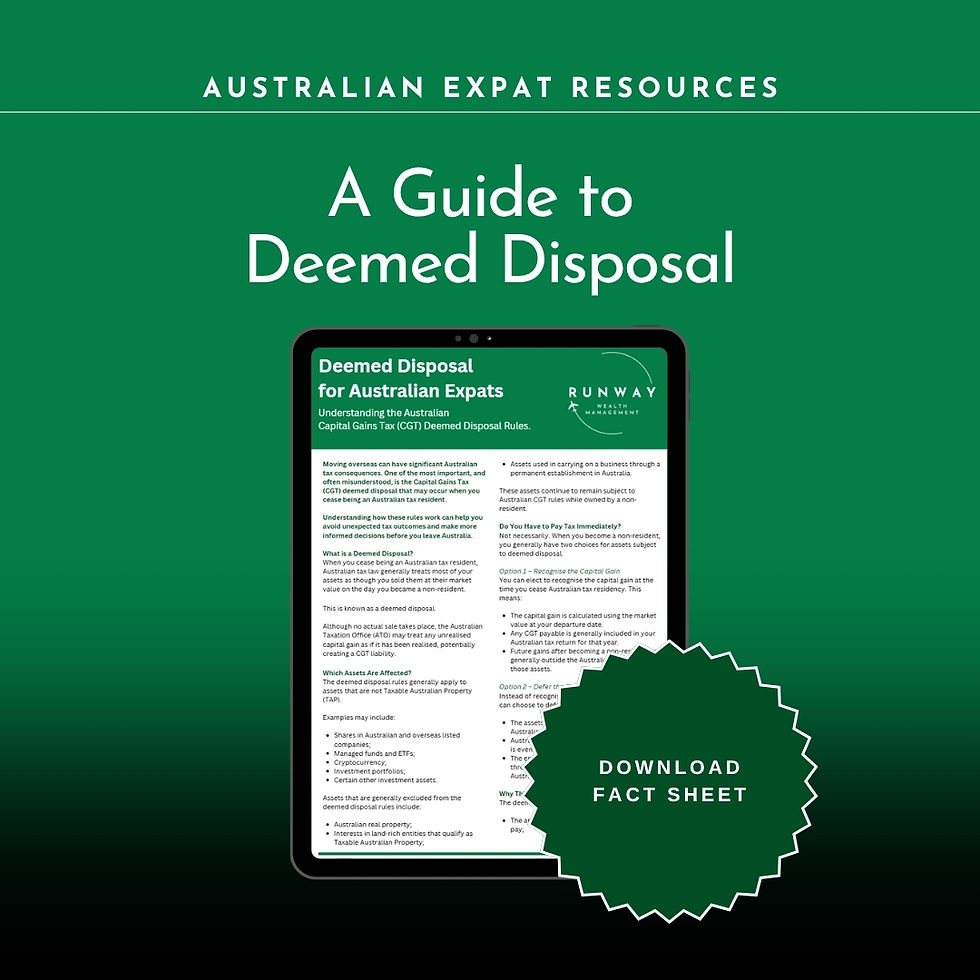
Fact Sheet: Deemed Disposal for Australian Expats
We also have a downloadable, print-friendly guide to Deemed Disposal for Australians living overseas.
What are the Deemed Disposal Rules?
Under Australia's Capital Gains Tax (CGT) legislation, when you cease being an Australian tax resident, you are generally treated as though you have disposed of certain assets at their market value on the day your Australian tax residency ends.
This is known as a deemed disposal.
Importantly, you haven't actually sold anything. Instead, Australian tax law creates a notional capital gains tax event that may require you to recognise any unrealised capital gains on affected assets.
The purpose of the deemed disposal rules for Australians who move overseas is to ensure that capital gains which accrued while you were an Australian resident can be taxed before those assets potentially move outside Australia's tax system.
Which Assets are Affected?
The deemed disposal rules generally apply to assets that are not Taxable Australian Property (TAP).
Examples include:
Australian listed shares;
International shares;
Exchange Traded Funds (ETFs);
Managed funds;
Cryptocurrency;
Certain other investment assets.
However, some assets are excluded from the deemed disposal rules.
These generally include:
Australian real estate;
Interests in entities that are classified as Taxable Australian Property;
Assets used in carrying on a business through a permanent establishment in Australia.
These assets generally remain within Australia's CGT system even after you become a non-resident.
You have Two Choices when it comes to the Deemed Disposal rules for Australians who move overseas
One aspect of the deemed disposal rules for Australians who move overseas that surprises many people is that there are generally two ways the rules can be applied.
Option 1: Recognise the Capital Gain when you Leave
The first option is to recognise the capital gain when you cease Australian tax residency.
Under this approach:
Your investments are valued at their market value on the date you become a non-resident.
Any capital gain is calculated using that market value.
The gain is included in your Australian income tax return for that financial year.
Future growth in those assets is generally outside the Australian CGT system (although it may be taxable in your new country of residence).
For some people, crystallising the gain at departure can provide greater certainty and simplify future Australian tax obligations.
Option 2: Defer the Deemed Disposal
Alternatively, you can choose to defer the deemed disposal.
If you do this, the assets continue to be treated as Taxable Australian Property (TAP) for Australian tax purposes.
Rather than paying tax when you leave Australia, Australian CGT will generally apply when you eventually sell those investments, even if that occurs many years after you have become a non-resident.
Whether this option is beneficial depends on your personal circumstances, expected investment performance, and the tax rules of your new country of residence.
How is Deemed Disposal Handled in Practice?
One of the most common questions we receive is whether Australians need to lodge a special form with the Australian Taxation Office when they move overseas.
In most cases, the answer is no.
Instead, the deemed disposal rules for Australians who move overseas are generally dealt with as part of your Australian income tax return for the financial year in which you cease Australian tax residency.
If you decide to recognise the capital gain at departure, you'll calculate the market value of each affected asset at the date your Australian tax residency ended. Those capital gains are then reported in the Capital Gains Tax section of your Australian tax return.
If, instead, you choose to defer the deemed disposal, you generally do not recognise the gain at that time. By making that choice, the affected assets continue to be treated as Taxable Australian Property, meaning Australia generally retains taxing rights over any future disposal of those assets.
Because your Australian tax residency may cease on a specific date during the financial year, not necessarily on 30 June, it's important to establish the correct residency cessation date before calculating any market values or capital gains.
Many people also obtain portfolio valuations or broker statements showing market values on their departure date to support their tax records.
An Example of the Deemed Disposal rules for Australians who move overseasConsider Sarah, who owns an investment portfolio consisting of Australian and international shares. She originally purchased the portfolio for AUD $300,000. When she permanently relocates to Singapore and becomes a non-resident for Australian tax purposes, the portfolio is worth AUD $500,000. Under the deemed disposal rules for Australians who move overseas, Sarah can generally choose between two approaches. The first is to recognise a capital gain of AUD $200,000 in her Australian tax return for the year she becomes a non-resident. Alternatively, she may choose to defer the deemed disposal. If she does, Australia generally continues to treat those investments as Taxable Australian Property, and CGT will usually apply when she eventually sells the portfolio. The better option depends on a range of factors, including expected future investment growth, the tax system in Singapore, and Sarah's long-term financial objectives. |
Common Misunderstandings
There are several misconceptions about the deemed disposal rules for Australians who move overseas.
One is that no tax can arise unless an investment is actually sold. In reality, a deemed disposal is a tax event created by legislation, even though ownership of the asset doesn't change.
Another misconception is that all assets are affected. Australian real property is generally excluded from the deemed disposal rules because it remains taxable in Australia regardless of where the owner lives.
Finally, many people assume deferring the deemed disposal is always the better option. In practice, there is no universally correct choice. The most appropriate strategy depends on both Australian tax law and the tax rules in your new country of residence.
Planning Before you Leave Australia
The best time to consider the deemed disposal rules for Australians who move overseas is before you become a non-resident for tax purposes.
Early planning allows you to:
Confirm the date your Australian tax residency is likely to cease.
Identify which assets are subject to the deemed disposal rules.
Obtain appropriate market valuations.
Compare the tax consequences of recognising or deferring capital gains.
Understand how Australia's rules interact with the tax laws of your destination country.
Review your broader investment strategy before departing.
Making these decisions before you leave often provides more flexibility than trying to address them after you've already become a non-resident.
Final Thoughts
For many Australians relocating overseas, the deemed disposal rules are one of the most important tax issues to understand. While the rules may appear straightforward, the decision to recognise or defer capital gains can have long-term implications for your Australian tax obligations, overseas tax position, and overall wealth strategy.
Obtaining advice before your residency changes can help ensure the rules are applied correctly and that your investment strategy aligns with your long-term financial goals.
Runway Wealth Management is the trusted Financial Adviser to the Australian Expat community. Our tailored advice is backed by expertise, education and experience, which allows us to be at the forefront of Australian Expat Financial Planning.
If you would like to speak to one of our Expat Financial Advisers about this blog or if you have other queries, we would be more than happy to speak with you. Feel free to send us an enquiry through the 'Contact Us' tab provided in the link below:
General Advice Disclaimer: The information contained herein is of a general nature only and does not constitute personal advice. You should not act on any recommendation without considering your personal needs, circumstances, and objectives. We recommend you obtain professional financial advice specific to your circumstances.


Comments